
Selected work
Content systems for categories buyers don’t understand yet.
Positioning and sales content for cybersecurity companies, each carried from buyer insight to the assets that close deals. Every image on this page is the actual deliverable.
 Case 01 · 4 deliverablesEnterprise security platformView case
 Case 02 · 5 deliverablesIncident readiness platformView case
 Case 03 · 2 deliverablesChannel & partner productView case
3 cybersecurity clients · 11 shipped deliverables
Case 01 · Enterprise security platform
QryptoCyber
Cybersecurity · Post-quantum cryptography
QryptoCyber builds the platform enterprises use to inventory and remediate cryptographic risk ahead of the quantum threat. JunoLabs built the content engine that explains why that matters, and makes the case to buy.
The brief
Post quantum cryptography is a hard sell. It’s deeply technical, still abstract to most buyers, and racing against government mandates most security teams haven’t fully absorbed. JunoLabs built a full library of content to carry QryptoCyber’s buyers from “what is this?” to “let’s talk,” spanning long form technical education, buyer readiness guides, and the collateral their sales team carries into the room.
What we delivered · 4

01 · Long form / eBook
The Technical eBook
A 25+ page deep dive on cryptographic inventory and quantum threat analysis, positioning QryptoCyber’s Plan → Discover → Act framework as the category standard.
Why it works
Written for security architects and CISOs who are past the “is this real” stage and need a working plan. The eBook moves in three acts that mirror QryptoCyber’s own framework: Plan lays out the regulatory timelines forcing the issue, Discover walks through building a cryptographic inventory from scratch, and Act turns that inventory into a phased migration roadmap.
It was built as gated content: a download that gives QryptoCyber’s sales team a legitimate, high intent trigger to follow up, rather than a cold outbound email. The structure and headings were also reused as the backbone for a companion webinar deck.
02 · Buyer enablement
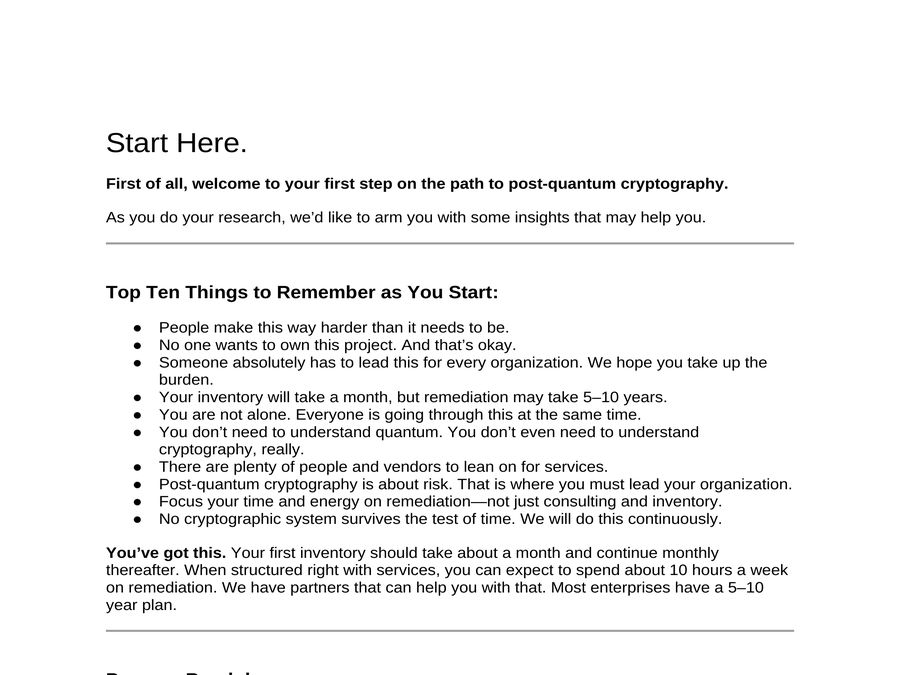
Start Here: A Buyer’s Guide
A plain language onramp for security leaders taking their first step toward PQC readiness, demystifying inventory, strategy, and remediation before they ever talk to sales.
Why it works
Most PQC content assumes the reader already knows what “cryptographic agility” means. This piece assumes nothing. It’s structured as a series of plain questions a buyer is actually asking themselves, “should I care yet,” “what do I even inventory,” “who owns this internally,” each answered in a few short paragraphs before moving to the next.
It sits earlier in the funnel than the Technical eBook: this is the first touch, not the deep dive. Sales uses it as a no pressure follow up after a first conversation, something a prospect can forward internally without it reading like a pitch.
03 · Thought leadership
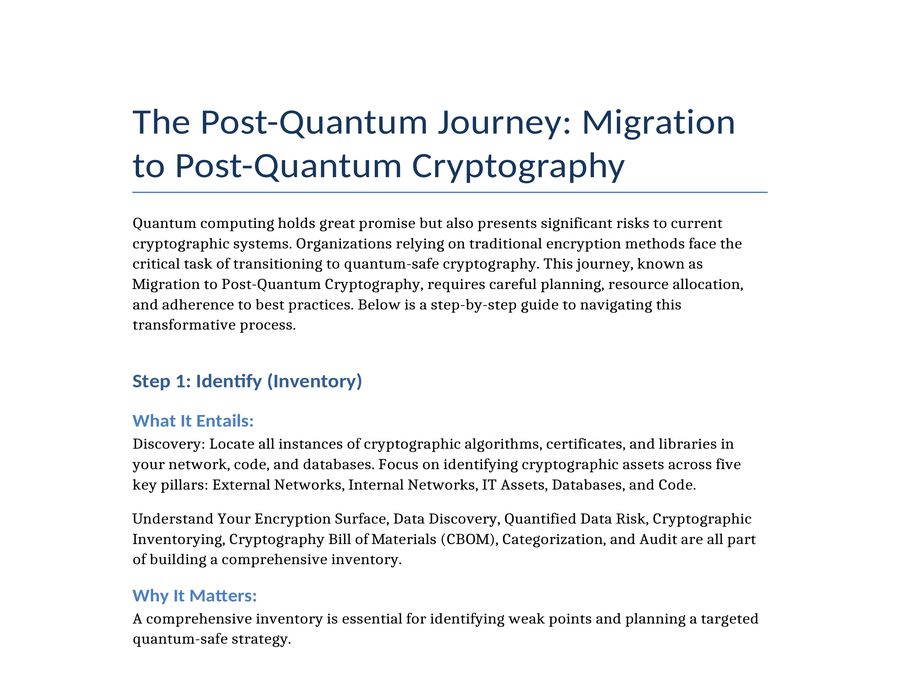
The Post Quantum Journey
A five step migration framework (Identify, Assess, Control, Remediate, Monitor) turned into a shareable strategic narrative for cross functional buying committees.
Why it works
PQC migration decisions rarely sit with one person. Security, IT, compliance, and procurement all need to agree before budget moves, and they don’t share a vocabulary. This piece translates the five stage migration framework into language each of those functions can nod along to, without requiring anyone to become a cryptography expert first.
Delivered as both a standalone narrative and as slide content QryptoCyber’s champions could drop directly into internal steering committee decks, so the framework spreads inside an account without JunoLabs or QryptoCyber needing to be in the room.
04 · Sales enablement
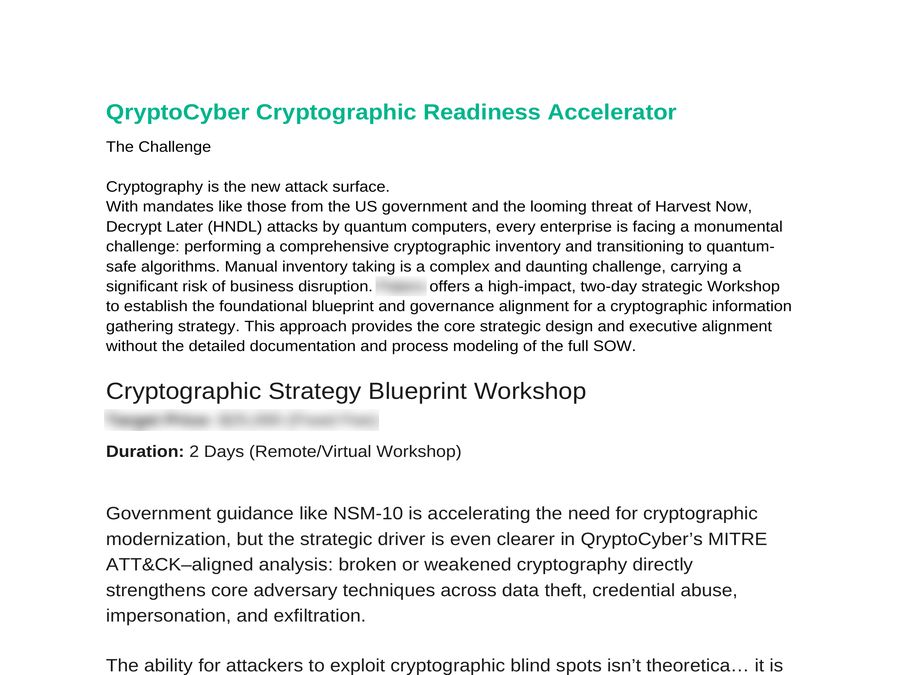
Cryptographic Readiness Accelerator
Program materials for QryptoCyber’s flagship strategic workshop offering, packaging a technical engagement into a clear, executive ready pitch.
Why it works
QryptoCyber needed a way to convert “we should probably look into this” into a signed, paid first engagement, without a lengthy sales cycle. The Accelerator materials define a fixed scope, fixed timeline workshop with a named agenda and a clear list of what the client walks away with, deliberately positioned as a starting point rather than an open ended consulting retainer.
These materials gave the sales team a concrete, priced offer to close on instead of an abstract conversation about “readiness,” shortening the gap between first meeting and signed statement of work.
Case 02 · Incident readiness platform
ChaosTrack
Cybersecurity · Incident readiness training
ChaosTrack replaces the once-a-year compliance tabletop with realistic, repeatable incident simulations that train teams under real pressure. JunoLabs built the story, the language, and the assets that turned that idea into a sellable category.
The brief
“Incident readiness” is easy to nod along to and hard to sell. Every prospect already believes they have a plan. JunoLabs built ChaosTrack’s core positioning from the ground up, then carried that single narrative, “you respond the way you train,” through every format its GTM team needed to open, advance, and close a deal.
What we delivered · 5
01 · Brand strategy
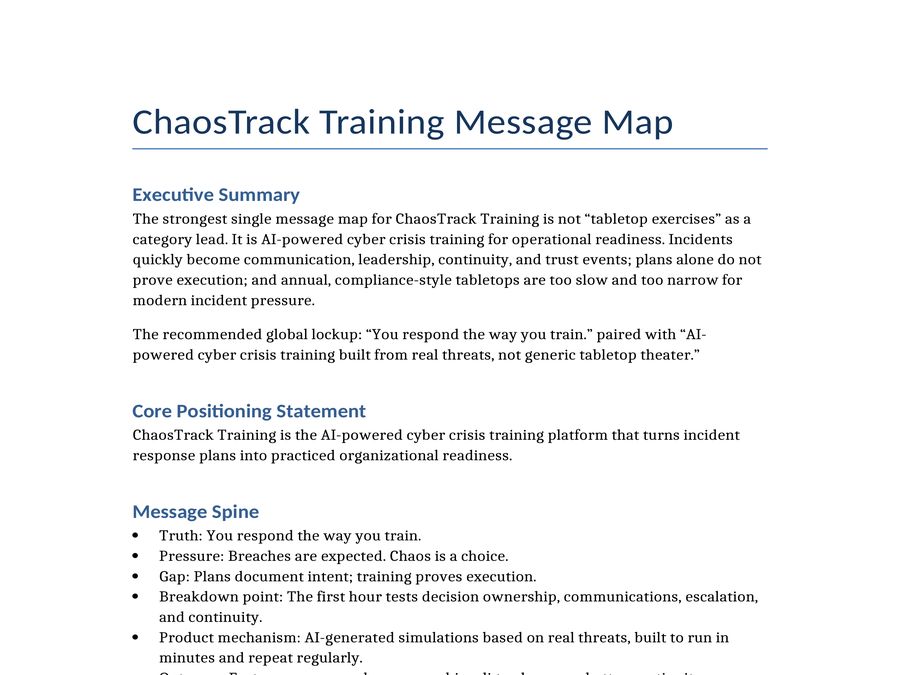
Message Map & Positioning System
The core narrative architecture: positioning statement, messaging pillars, audience specific value props, and a full headline & voice system built to hold up across every channel.
Why it works
Before any asset gets written, every word choice needs a source of truth. This system defines ChaosTrack’s positioning statement, three messaging pillars, and a value proposition for each distinct buyer (CISO, incident response lead, compliance owner), along with the objection language for the pushback each of them gives first.
It also sets the voice and tone rules that let anyone, JunoLabs or ChaosTrack’s own team, write a new asset that sounds consistent, without needing to reinvent the positioning from scratch each time.
02 · Sales collateral
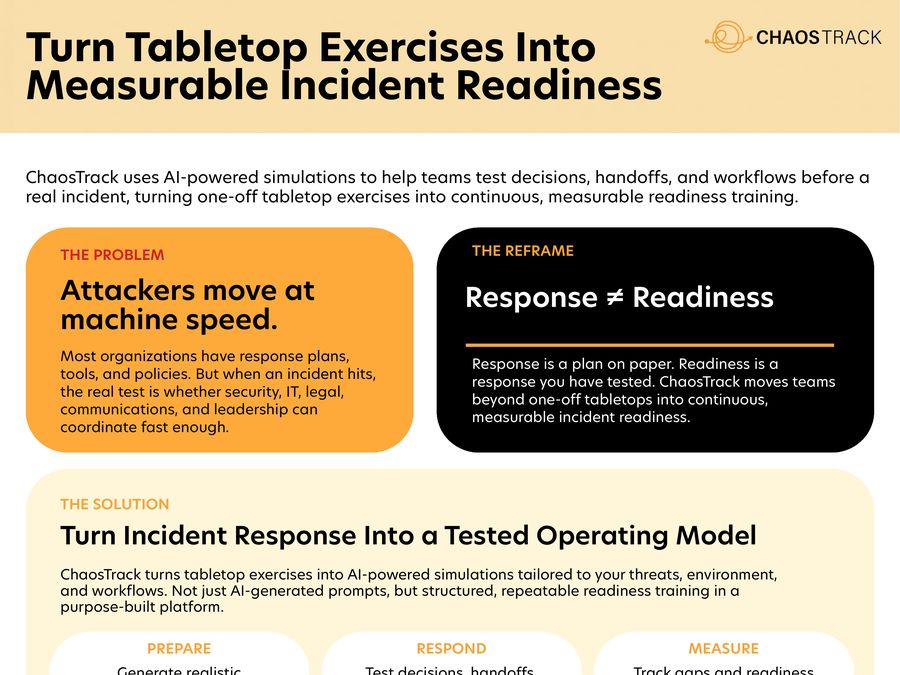
Sales One Pager
The single page conversion asset: problem, reframe, and outcomes distilled into a page a rep can send cold and a prospect can grasp in under a minute.
Why it works
Structured in the order a skeptical reader actually processes a pitch: the problem stated in their own words first (“your tabletop hasn’t been tested under real pressure in years”), then the reframe (“incident readiness, not incident response”), then the proof, then a single clear next step.
Built to survive being forwarded with zero context. A rep can send it cold, and a prospect who has never heard of ChaosTrack can understand the pitch without a call first, or hand it to a colleague who will.
03 · Sales enablement
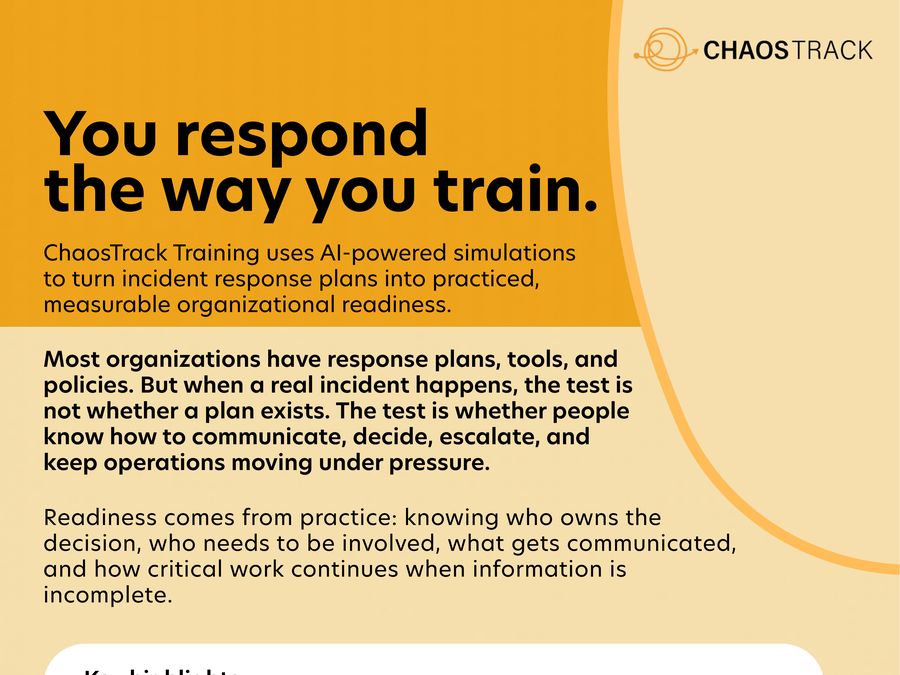
Solution Brief
A six page narrative brief covering the shift, the gap, and the new requirement, built to carry a champion through internal buy in conversations.
Why it works
Every deal has a champion who has to sell it internally after the call ends, usually to people who never spoke with ChaosTrack directly. This brief is written for that second conversation: the shift (why annual tabletops stopped being enough), the gap (nobody trains under real pressure), and the new requirement (continuous, measurable readiness as the standard, not the exception).
It’s deliberately narrative rather than a spec sheet, so a champion can walk a skeptical VP through the logic in their own words instead of just forwarding a PDF and hoping it lands.
04 · Sales deck
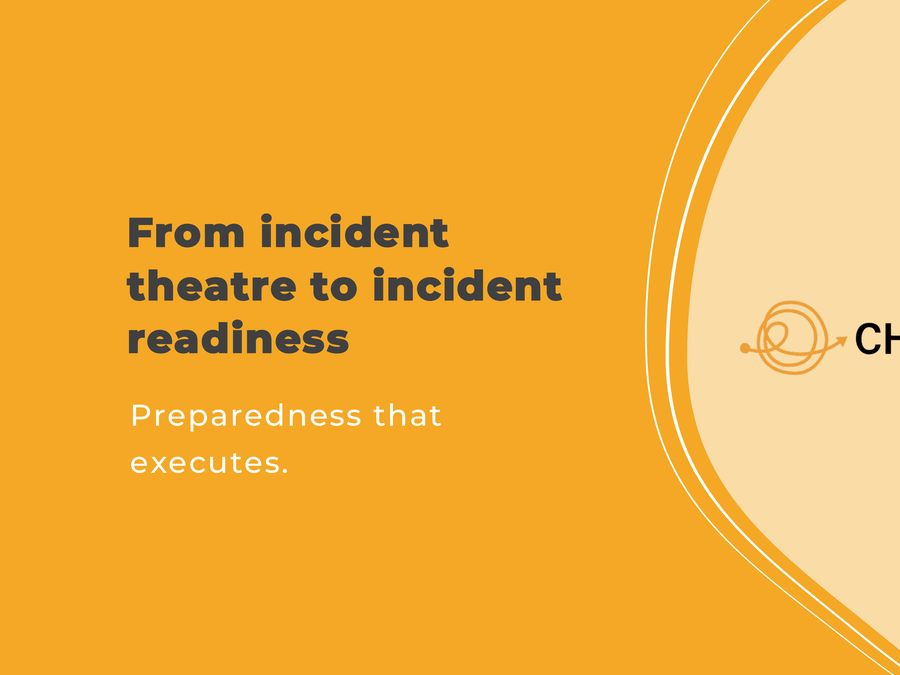
GTM Sales Deck
The pitch deck ChaosTrack’s team presents live, reframing “incident response” as “incident readiness” and closing on a clear, provable outcome.
Why it works
Built to work two ways: live, with a rep talking through it, and cold, when a prospect reopens it after the call with no one there to narrate. The structure moves from problem to category reframe to proof to a specific, provable outcome, deliberately avoiding the generic “about us” opening most sales decks lead with.
Every slide earns its place in both settings, which meant cutting anything that only worked as a spoken aside and rewriting it as something that reads clearly on its own.
05 · Content strategy
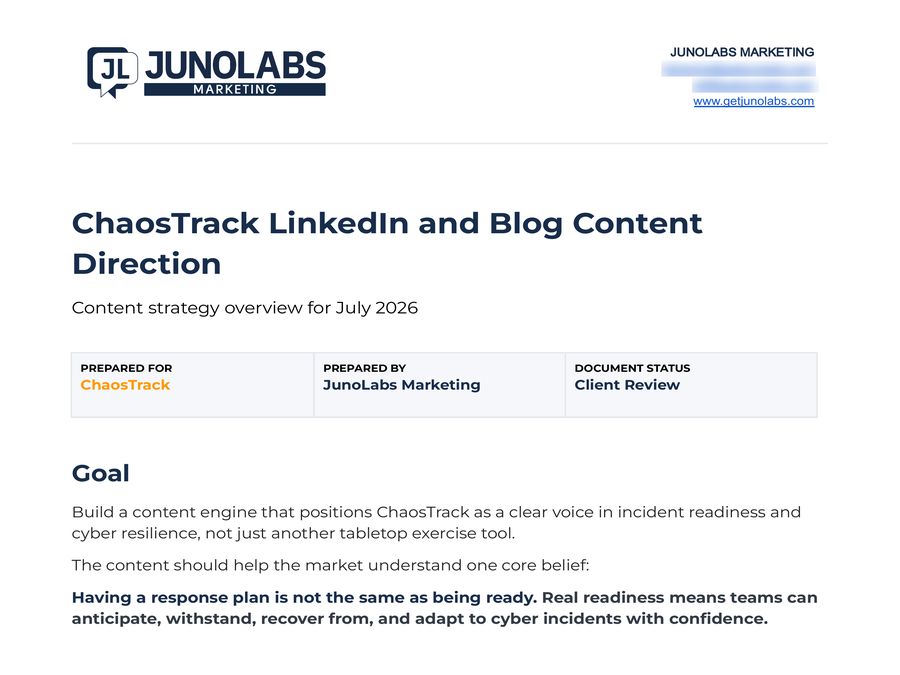
LinkedIn & Blog Content Direction
An ongoing editorial system: five content pillars and a recurring cadence, built to own the conversation around cyber resilience beyond the SOC.
Why it works
Five pillars anchor the calendar: incident simulation and readiness testing, compliance tabletop fatigue, red team culture, real world tabletop failure stories, and category education for buyers who haven’t heard of “incident readiness” as distinct from “incident response” yet.
Written in the founder’s own voice rather than a generic brand voice, since thought leadership content in this category reads as more credible coming from a named person than from a company account. The cadence was built to be sustainable without a dedicated content hire.
Case 03 · Channel & partner product
Risk Foundry
Cybersecurity · Automated risk assessment, MSP & reseller channel
Every regulated business owes a yearly cyber risk assessment. Almost none of them know it. Risk Foundry turns that gap into a one hour, self serve assessment, and a channel product MSPs and resellers can put their own name on.
The brief
The hard part wasn’t the product. It was the pitch. JunoLabs had to sell channel partners on reselling something they didn’t build, wrapped in a compliance topic (NIST, CMMC, SEC, HIPAA, GLBA) their own customers weren’t asking about yet. The result: a partner facing pitch that reframes an ignored requirement as an upsell, and a self serve product site simple enough to hand a customer with zero explanation.
Live at onehourriskassessment.com ↗
What we delivered · 2
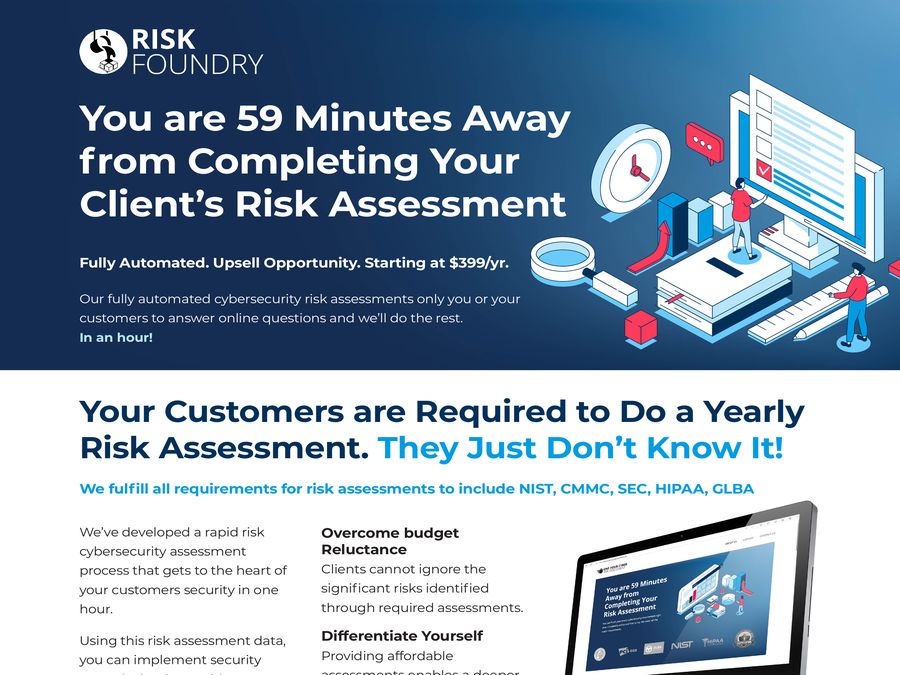
01 · Sales collateral
Partner One Pager
The reseller facing pitch, “you’re 59 minutes away,” structured across three investment tiers, from a free branded site to a fully white labeled application.
Why it works
The hardest objection to overcome wasn’t price, it was ownership: why would an MSP put their name behind a compliance product they didn’t build. This piece answers that directly before it even gets asked, then walks through three tiers of investment, from a free branded microsite up to a fully white labeled application a partner can present as entirely their own.
The “59 minutes” framing turns an ignored, dreaded annual requirement (NIST, CMMC, SEC, HIPAA, GLBA) into something a partner can position as a fast, low friction upsell to their own customer base.
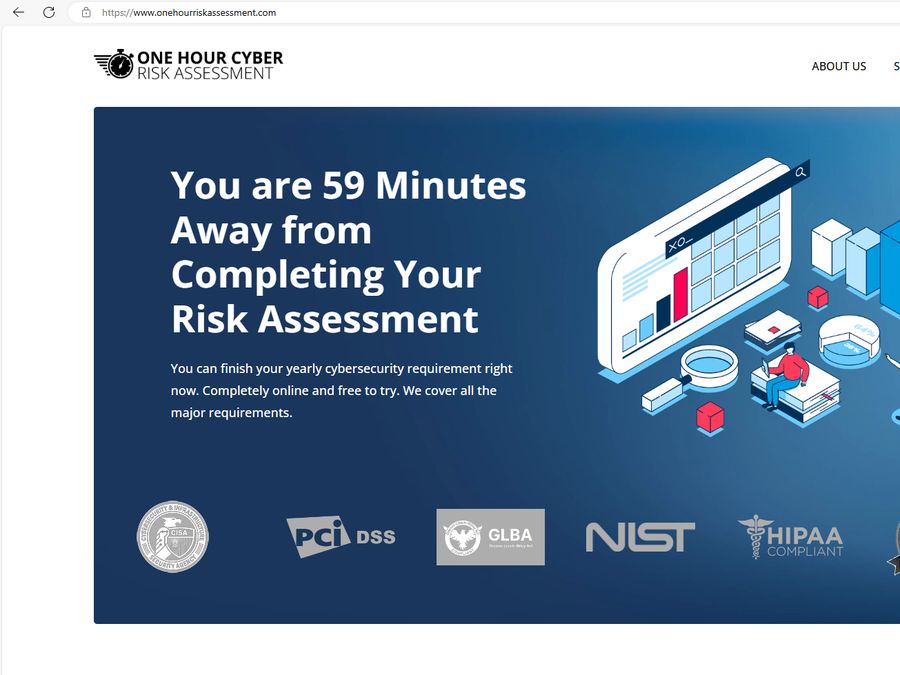
02 · Web product
One Hour Risk Assessment site
The self serve site partners hand straight to their customers, live at onehourriskassessment.com: plain language questions in, a compliance ready report out, no consultant required.
Why it works
Everything above the fold answers one question before the visitor has to ask it: “can I trust this enough to start?” The “59 minutes” headline lowers the perceived cost of starting, and the row of compliance marks (CISA, PCI DSS, GLBA, NIST, HIPAA) borrows credibility from frameworks the visitor already recognizes.
Every question is written in plain language rather than compliance jargon, and there’s no login wall, gated PDF or “book a demo” in the way. The output is a report formatted to hand straight to an auditor, and the branding swaps to any partner’s identity without engineering involvement, which is what makes the whitelabel model scale.
Start with the Assessment · 1 week · NDA